It is Saturday morning at the Humanitarian Hub in Brussels.
Before the first meal is served, there is already plenty to do. Bread needs to be cut. Hands of bananas needs to be divided into individual fingers. Thermal boxes with meals need to be organised. Volunteers move between the storage, the canteen and the distribution area, making sure everything is ready.
Then the doors open.
One person takes a tray. Another receives a meal. A quick “thank you” is exchanged. Someone smiles. Someone else comes back for a second portion.
It might look like a simple lunch distribution. But behind every meal is a team of people making sure that, on Saturday and Sunday, there is still something warm to eat.
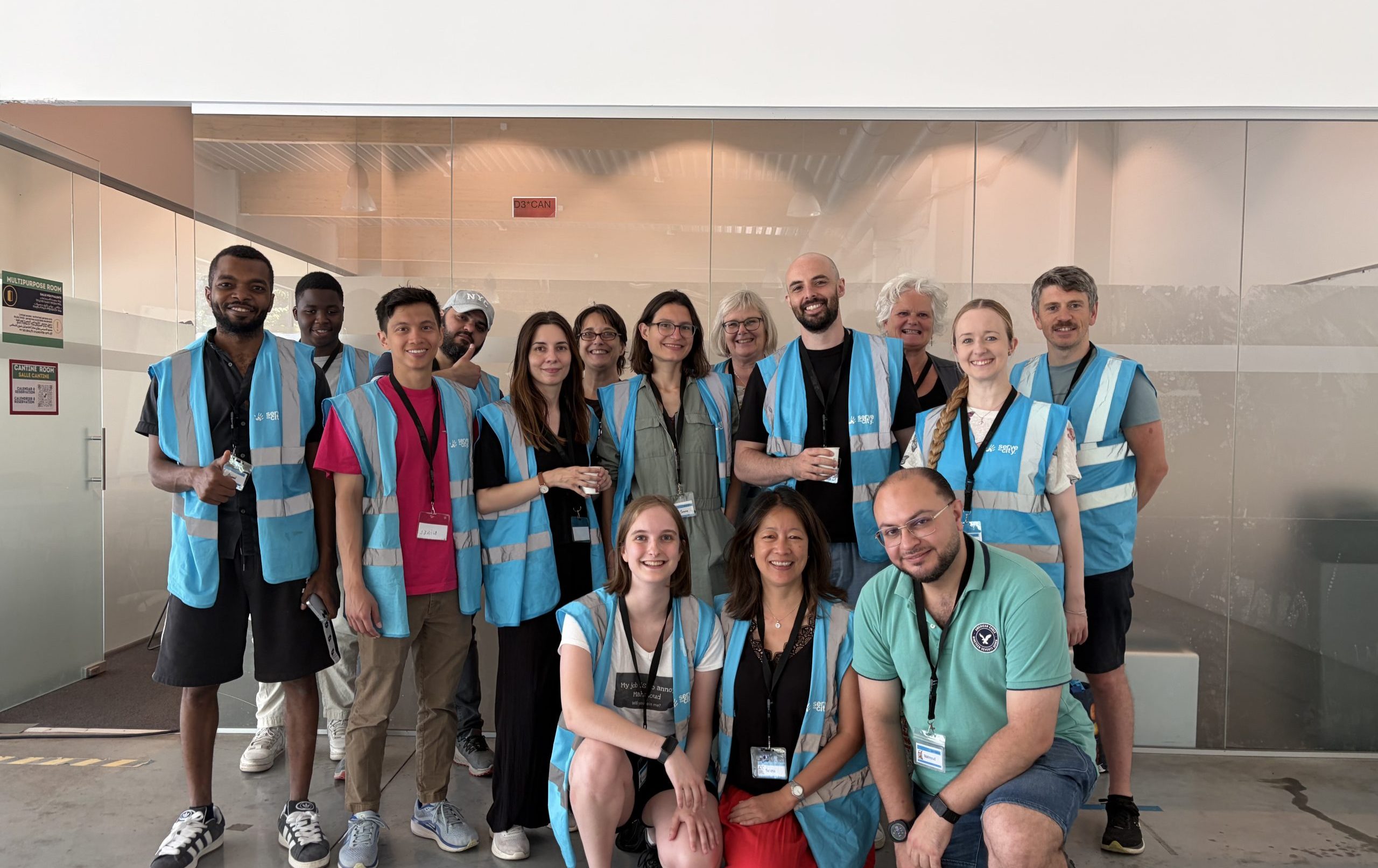
Since April 2026, Serve the City volunteers have taken on the responsibility of managing the weekend lunch distributions at the Humanitarian Hub, ensuring all those who need that support are able to get it. It is a new challenge for the team, and one they have embraced with determination.
There are still people who arrive on a Saturday and Sunday morning ready to work. Still people who cut bread, carry banana boxes, tables to prepare and clean, meals to hand out. Still people who believe that everyone deserves a meal and a moment of dignity.
The situation at the Hub is difficult. The future is uncertain. The need for sustainable solutions remains urgent. But the volunteers are there. And they are up to the challenge.
– Mahmoud, Volunteer Project Leader of Lunch 4 All
The timing has not been easy. Since early 2026, the Humanitarian Hub has lost half of its funding. With fewer resources and fewer staff, the organisation has had to reduce the services it can provide. The number of food distributions has been reduced as well: there are now two fewer distributions, with only one distribution -lunch- taking place each day on Saturday and Sunday. For the people who rely on the Hub, these changes are significant.
Created in 2017, the Humanitarian Hub has become an important place of welcome and support for people experiencing migration and homelessness in Brussels. Today, it is run by a consortium of Doctors of the World, Doctors Without Borders, the Belgian Red Cross and BelRefugees. The Hub offers a range of essential services, including a day centre, showers, clothing, medical and mental-health consultations, food distribution, administrative and legal support, family-reconnection services and support for unaccompanied minors. In 2024 alone, the day centre recorded 111,236 visits.
But the needs have not disappeared.
In fact, while resources have been cut, the pressure on the Hub has continued to grow. In July 2026, 84 families requested emergency accommodation -the highest monthly figure recorded in 2026- and almost half of those families were left without a solution at the end of the day. This is the reality behind the lunch queue.
And yet, on the weekends, there is something else happening. Volunteers are stepping forward. Taking over the food distribution means taking responsibility for much more than handing out meals. Volunteers are needed in the canteen, in meal preparation, in setting up the distribution and in keeping everything running smoothly.
The circumstances are difficult. The workload is real. The need is greater than the resources available, but the volunteers are doing an excellent job. At the Hub, there is some security and a Red Cross coordinator supporting the operation. Around them, volunteers make the distribution happen. One task, one tray and one meal at a time. The challenge is big, but so is the response.
And perhaps that is one of the most encouraging things to see at the Humanitarian Hub right now: when circumstances become harder, people are still willing to step forward.
– Nathan, Serve the City Executive Director
On Sundays, meals are cooked by Cuistots Solidaires. On Saturdays, Community Kitchen provides the food. The Serve the City team then makes sure that the meals reach the people who need them. The goal is not simply to keep the distribution going. The team is trying to increase the quantities of food prepared and served, and that requires more hands. More volunteers arriving early. More people helping in the preparation. More people helping in the canteen. More people handing out meals. More people willing to take on the small tasks that, together, make the whole operation work.
That is exactly what volunteering at the Hub looks like: not one big heroic gesture, but dozens of practical acts of solidarity coming together.
The Hub itself is operating in an increasingly difficult environment.
With funding reduced by half since April, staffing levels have also been cut significantly. Médecins du Monde reported in August that the consortium had even been forced to temporarily close the day centre and support services for two days because chronic understaffing had made it impossible to guarantee the safety and wellbeing of everyone involved. Food distribution nevertheless continued.
The wider political context is tense too. Brussels is facing difficult discussions around migration and reception, while the federal government has announced the removal of 1,000 reception places in the city. Meanwhile, many people continue to find themselves without a place to stay.
The demonstration taking place in Brussels on 18 August is another visible reminder of how sensitive and difficult the current situation has become.
Volunteers cannot solve these structural problems.
They cannot create housing.
They cannot replace public policy.
They cannot make a humanitarian crisis disappear.
But they can make sure that, when someone arrives at the Hub on a Saturday afternoon, there is a meal waiting. And sometimes that matters enormously.